Wednesday
Jun092010

Party 101: The Prequel

The northeast corner of Spring and Mercer Street was bubbling with excitement last Thursday night when Rainer Judd, President of the Judd Foundation (and daughter of Don Judd) announced to a room full of Judd family, friends and followers that this day, June 3, her father’s birthday, begins the public phase of a capital campaign developed to help fully restore Donald Judd’s historic home at 101 Spring Street, a major landmark in preserving Judd’s legacy.  The space will be closed during the estimated 3-year restoration period but the Foundation will remain active through various programs, events and projects including work on developing the Judd catalogue raisonné. 

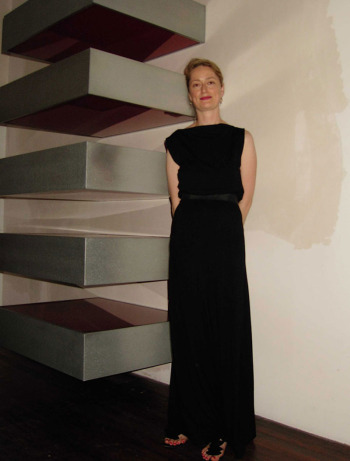
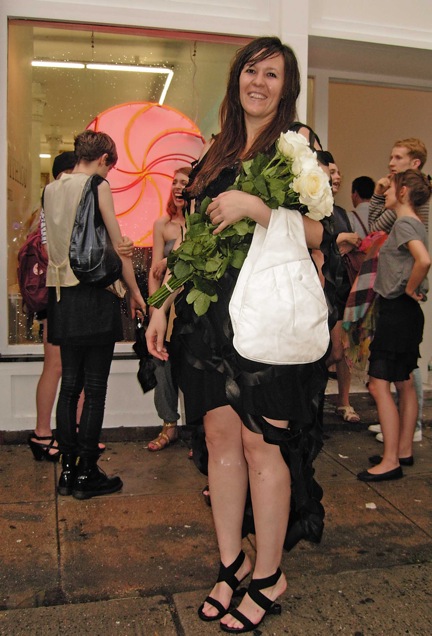
Rainer Judd wearing a black column dress by award-winning fashion designer, Yeohlee Teng aside ‘Untitled,’ 1978 a classic Donald Judd stack piece. 101 Spring Street, New York City, June 3, 2010.The ground floor of the building was transformed into a summer picnic area complete with Judd-designed tables and benches made from unfinished modest pine with a buffet of rare steak, fries, arugula, and prosciutto served by Giorgio Deluca, one of the founders of the pioneering SoHo gourmet food emporium Dean & Deluca.  Rainer Judd took center stage and kicked off the campaign with a tribute to her parents: “101 Spring Street has been called the ‘jewel of SoHo’ because it glows at night with a Dan Flavin sculpture made especially for the 5th floor, and because an artist named Don Judd and his wife Julie took a stand, along with a small renegade community of artists, against Robert Moses’ plans to raze the entire neighborhood to build the Broome Street Expressway – and won!  If there’s any surviving building in SoHo that captures the vision of a single artist, the spirit of loft-living, and the art of a generation, it is 101 Spring Street.”  It would be undeniably worthy if the new guard of SoHo, major brands like Louis Vuitton, Burberry, Chanel, J Crew, etc., stepped up to the plate and contributed to the restoration of this visionary building where one artist had the brilliant idea to merge art, architecture and life and in so doing rescued what is now the world-famous cobbled grid SOuth of Houston, SoHo.  Donate to the Judd Foundation at: http://www.juddfoundation.org/donate.htm

http://www.artnet.com/Magazine/people/barone/barone9-10-04.asp

Tuesday
Jun012010

Thus Spake Otto Dix

‘This is the way the fucking world ends! Look at this fucking shit we're in man! Not with a bang, but with a whimper. And with a whimper, I'm fucking splitting…’ the Photojournalist portrayed by Dennis Hopper in Francis Ford Coppola’s 1979 war film epic Apocalypse Now.

Like so many hardcore lines uttered in Francis Ford Coppola’s legendary Vietnam War film Apocalypse Now (translated in over 30 languages), the purely visual terms of war paintings by Otto Dix (1891-1969), namely his lost epic painting Schützengraben ‘Trench,’ cast forth in honest detail ‘the horror’ from the front line of war where Dix, a youthful budding artist, went in search of meaning.  No artist is as strongly linked to the historical events of twentieth-century World War I Germany as Dix.  Driven out of his position by the Nazis, he was able to live and paint long enough to see his work hailed again for its unique power. http://www.neuegalerie.org/exhibitions/otto-dix

In his 125-page biography Otto Dix, The Art of Life, the German art historian Philipp Gutbrod concisely examines the artist through the lens of this long lost masterpiece Schützengraben ‘Trench,’ and in so doing provides the reader vast insights into Dix’s creative impulse. Beginning with his childhood and youth in Thuringia, on to art school in Dresden and, soon after in 1915 at the French front in the Champagne region fighting as a machine gunner, Gutbrod eloquently recounts the artist’s fearless creative path.  He writes that in1963, while reflecting on World War I, Dix explained his lengthy participation in the war: ‘I had to see it for myself.  I am a realist to such a degree that I had to see it with my own eyes to be able to confirm that it is how it is.’


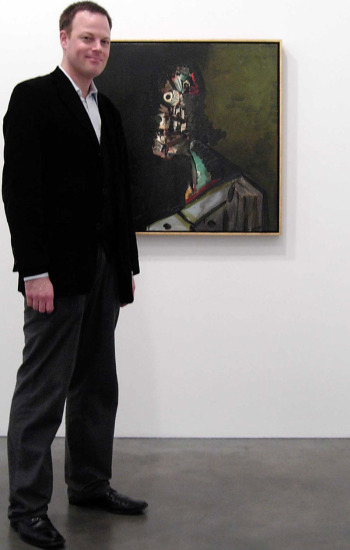
Philipp Gutbrod at the Andrea Rosen Gallery, Chelsea, NYC, May 12, 2010, with work by George Condo.

Otto Dix, The Art of Life by Philipp Gutbrod published by Hatje Cantz Verlag is available on May 31, 2010 online at http://www.artbook.com/9783775725811.html
and at the Neue Galerie bookstore http://www.neuegalerie.org/shops/Book%20Store


Friday
May142010

…while visions of sugar plums danced in my head

Chef Gutenbrunner test-driving his Nürnberg Bratwurst at a Taste of Tribeca preview, April 28, 2010

On the Eve of the 16th annual Taste of Tribeca a celebration of over 60 restaurants and chefs in lower Manhattan, my mouth watered reviewing some of the dishes to be served up like Nürnberg Bratwurst, a mini bratwurst with sauerkraut, potatoes, horseradish and watercress carefully developed by the wildly talented Kurt Gutenbrunner of Blaue Gans, a Tribeca outpost favored by art world cognoscenti. Other menu highlights include a braised lamb neck and carrot ravioli with koppert cress pea shoots, the invention of chef Marc Forgione of two-year old restaurant Marc Forgione and Nobu chef Ricky Estrellado’s chicken karaage with green mango and jicama slaw.


Taste of Tribeca invites food lovers to the annual school fundraiser on Saturday, May 15 from 11:30 am to 3pm on Duane Street (between Greenwich and Hudson). The fabulous outdoor event, centered along Greenwich Street, completely supports arts programs like music and dancing as well as science classes at Tribeca’s PS 234 and 150 public schools. Tickets are $40 in advance and $45 on the day of which buys six generously portioned tastes. It’s a recession special like no other and with a forecast for sunny skies and temperatures in the 70s it’s bound to be the toast of downtown. Tickets can be purchased at www.tasteoftribeca.org

Wednesday
May122010

Philip Glass is in the House!

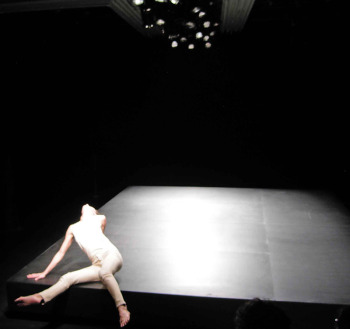
Molissa Fenley performs ‘Variation II’ from “Dreaming Awake,” 2006 a work she choreographed with music by Philip Glass performed by Pedja Muzijevic, at Danspace Project 2010 Gala honoring Philip Glass, NYC, April 27, 2010.

On an unseasonable chilly spring evening, the dance world came out in full force to celebrate Philip Glass, one of the greatest American composers of the late 20th century. On April 27, Glass received the highest honors given by Danspace Project for his significant contributions to American dance and his major impact on international art and culture.   Born in 1937 in Baltimore, Maryland he studied at the University of Chicago, the Julliard School and in Aspen with Darius Milhaud but gained his musical footing in Europe under the tutelage of the legendary pedagogue, Nadia Boulanger  (who also taught Aaron Copland, Virgil Thomson and Quincy Jones) and from his work with sitar virtuoso and composer Ravi Shankar.  In 1967 Glass returned to New York and formed the Philip Glass Ensemble and the rest is (art) history.

Fellow music pioneer Laurie Anderson and the painter Chuck Close each gave personal accounts of their respective creative collaborations with Glass.  Chuck Close reminisced the early years of his friendship with the composer at the moment in the late 60s ‘before Soho was Soho, when it was just industrial New York [and] so much was shared then, so much was in the air.’  He made the point that ‘it wasn’t direct influence but a kind of back and forth.  There were painters and composers – not just Phil but Steve Reich – and dancers like Trisha Brown.  And we all showed up for each other.  All Phil’s early performances were in museums and art galleries, for example.  The music world was way not understanding.'

Now in it’s 35th season, Danspace Project continues to support a diverse range of choreographers in developing their work.  Danspace Project’s Commissioning Initiative has commissioned over 360 new works since its inception in 1994.  Support Danspance Project at:  http://www.danspaceproject.org/support/gala.html

Saturday
May082010

‘Upside down, Boy you turn me, Inside out, and round and round’ 

Martin Creed, the English born, Scottish bred artist is well known as the ‘lights-on, lights-off’ Turner Prize winning sensation. Over the years he has consciously made works of art that use the exact amount of materials like Work No.201, half the air in a given space where he calculated the amount of air in a room, then filled balloons with exactly half the air and unloaded them into the space.  Out of a simple experiment like measuring the density of air, Work No.201 exhilarated even the most modest of humans, as they bounced around in squeals of delight on Creed’s sea of latex.

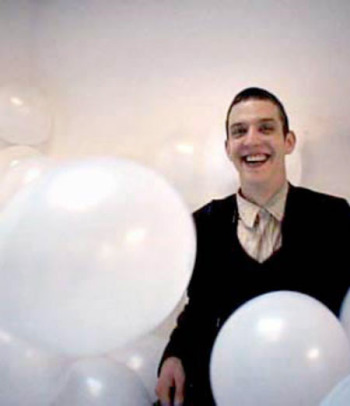
Martin Creed, London, 1998. Photograph by Mary BaroneReturning to New York this weekend for his third solo exhibition at Gavin Brown’s enterprise (GBE), Creed will continue to wow the masses creating a spectacular site-specific installation remaking the entire gallery floor at GBE’s 620 Greenwich Street space with a horizontal arrangement of more than 100 types of marble from around the world all sourced through a foundry in Carrera, Italy.  Creed said he likes to think of the piece as the whole world, a line that forms a linear equation of a permanent installation he created in 2003 to inaugurate the GBE space when it relocated from 15th Street to 620 Greenwich Street. Work No 300: the whole world + the work = the whole world, a black painted text wrapping around the corner of the GBE building’s white brick façade is a mission statement, a manifesto declaring the continuity between artistic gesture and everyday life.

Seven years later, GBE will inaugurate another space, a gallery expansion into the old LaFrieda Meat Purveyors building next door at 601 Washington where Creed will premiere a new work: a film of an erection, a 35mm black and white film of the torso of a naked man in profile achieving an erection. Like a time-lapsed photographic study of manhood, a film of an erection is accompanied by a new chromatic composition by Creed played by a live violinist from the Manhattan School of Music during the run of the exhibition. He will also show Work No.909, a black stage curtain calibrated to open and close at regular intervals.  The three separate rigorously time-based artworks have not been sequenced and will take on natural rhythms.  While the violinist moves up and down a 12-note scale, the curtains will flowingly open and close all the while the film of a man’s penis slowly rises up and down.  States of flux never felt so tranquil.

Martin Creed in rehearsal with violinist Akiko Kobayashi at the newly expanded Gavin Brown enterprises (GBE), 601 Washington, New York City, May 7, 2010 (photograph by Mary Barone)Martin Creed at Gavin Brown’s enterpise (GBE) opens May 9, 2010 with a reception for the artist from 4-6pm.  The exhibition will be on view through June 19, 2010. http://www.gavinbrown.biz/